Back to home page Yalland Vacuum Compressed Silage
ORGANIC BEEF AND LAMB
FROM PERMANENT PASTURE
ON HILL FARMS
A 21st CENTURY SYSTEM FOR YOUNG FARMERS
(Written in 2009)
David J. Lance Dip. Ag. HAAC
This page is in his own words. David J. Lance died in July 2024 (age 85).
Making a living from cattle and sheep on enclosed grassland has never been easy, and today, in this Cinderella sector of agriculture, the commercial farmer using twentieth century methods has been left high and dry. The job needs to be approached in a different way now. The best possible use must be made of what nature has to offer, particularly in the matter of soil fertility. From a fertile soil comes productivity and health, and unlikely as it may seem at first sight, there is a better chance of economic success producing red meat on enclosed grassland family farms of a certain optimum size, than ever there is on larger, less efficient holdings.
This article outlines an ecologically balanced scheme specifically designed for producing single-suckled beef and prime lamb cheaply from grass. It is a whole-farm system, particularly suitable for competent young couples starting out in agriculture. Thirty years of experimental husbandry at Yalland, a farm in the foothills of Dartmoor, established that when the proper needs of the five main “players” in the enterprise are catered for, viability and a satisfying way of life can be achieved.
These are the players:
The farming family - the husband and wife “team”
The soil – the fertility factory
The clover and herb rich permanent pasture – the low cost complete ruminant feed
The half-bred and crossbred prime lamb dams - the economic engine
The single-suckling beef cows - the vital companions of the sheep
In order to manage these five elements in a mutually beneficial way, a distinct policy was developed. The policy incorporates the following observations and recommendations, which will be discussed at greater length later on:
1 – 55 ha (135 acres) is the minimum area of grassland needed for the economic production of red meat
2 - The husband and wife “team” is flexible and durable; it is unsurpassed, the ideal management and labour unit for efficient red meat production
3 - A live weight balance between cattle and sheep is required for best performance, lowest cost and manageable workload throughout the year
4 - Stressful situations for both animals and humans should be avoided: too much competition is bad for animals; too little time is bad for the family
5 – Permanent pasture should be managed to provide appropriate feed for earthworms, as well as all sub-groups of cattle and sheep
6 - The principle winter feed for both earthworms and cattle can be provided by autumn-saved-pasture
7 - February and March born early maturing beef calves should not need concentrates at any stage, and will fatten off grass at 15 to 18 months
8 – 30% dry matter high quality silage should be fed to sheep in winter, purchased concentrates should be avoided, or reduced to a very low level
9 - Sheep should be in-wintered to aid shepherding, reduce feed waste and to allow more pasture for the controlled winter-feeding of cattle
10 – Composted FYM from the sheep yards should be spread on the silage fields in August, after the first grazing by weaned lambs
The sort of husbandry indicated here reduces costs dramatically, simplifies management and increases output per acre. The proposition is put forward that in the “red meat from enclosed grassland” sector of agriculture, it is sounder agriculturally, better economically, more satisfactory for the family, the community and the country, to have more viable family farms of around 60 ha (150 acres), than it is to have fewer, larger, less efficient farms employing labour and contractors.
Discussion
Yalland System Beef and Lamb is compatible with the highest biological standards, and is specifically designed for producing single-suckled beef and prime lamb cheaply and efficiently from permanent pasture. Why permanent pasture? Because when managed according to the basic rules of good grassland husbandry, it is the cheapest, most durable and versatile form of grassland. Permanent pasture also happens to be “environmentally friendly”, and is all you need to qualify for any environmental scheme.
The Yalland system enables the husband and wife to make a living from full-time farming in what has always been, and still is, the most impoverished sector of agriculture, that is, “cattle and sheep on enclosed grassland”. As already stated, a minimum of 55 ha (135 acres) of pasture is required, which, for reasons of bio-security and efficiency, should be in a ring fence. This is the optimum size for economic production – Landlords, please note. Expansion much beyond this size is not only self-defeating in terms of income, but also reduces quality-of-life, surely one of the main reasons for farming in the first place. A lesser area will reduce enterprise efficiency and the turnover needed for a reasonable standard of living.
For some young couples, the most perfect and natural way of life is to farm, raise a family and play an active part in the local community. It is fortunate for the country at large that this is so, because these families are the backbone of agriculture in the hills. Without the commitment of family farmers productive land would be lost, and the countryside would quickly revert to a wasteland of brambles, bracken and gorse. The time cannot be far away when Britain will need its own supply, not only of healthy grass-fed red meat, but also the by-products wool and leather.
Stock rearing country, with its hills, valleys, narrow roads and smaller fields to shelter the animals, is unsuited to large-scale operations. The doctrine that suggests fixed costs are reduced by “getting bigger” ain't-necessarily-so in the hills. Over mechanization and land dislocation lead to expensive, time consuming travel. The result, inefficiency, dissatisfaction, poor standard of work, low production per hectare and unnecessary complexity. On top of this is the liability to unpredictable traffic in the lanes when conserving winter feed, for example, and in the winter when roads can become impassable.
Furthermore, a compact farm of optimum size that has been designed for the job, has a distinct advantage at times when outbreaks of disease cause restrictions to animal movements. The farm can still function as planned, and movement to slaughter is always the first restriction to be lifted once the initial panic of an outbreak is past. It goes without saying, that general bio-security is more effective and easier to manage on a compact family farm where no regular labour is employed and few contract services are needed. In addition to this, the installation of specially designed electrified permanent fencing to exclude foxes and badgers from the livestock sections of a farm, and to provide a safe haven for ground-nesting birds, wild honey bees and hedgehogs, becomes a practical proposition.
The earthwormholds the key to cheap sustainable soil fertility, and provided the farmer looks after the earthworm's special needs, the soil will improve and the number of worms and other soil life will increase with every year that passes. A look at what the earthworm can do for permanent pasture when conditions are favourable is quite an eye opener:
Earthworms will deposit 30 tonnes per ha (12 tons per acre) of castings in and on the soil each year
When compared with the surrounding soil, these castings contain: 5x more nitrogen, 7x more phosphate, 11x more potash, 16x more magnesium and 21x more calcium
In addition, earthworms account for 75% of the crumb structure and 75% of the humus in our soils, to increase vital water holding capacity
Crumb structure allows air and roots to penetrate the soil, and excess water to drain away. Humus is a product of decomposition, a colloidal substance that stores water and holds plant nutrients against leaching.
Earthworms harvest and consume fungus-infected (source of protein) vegetable matter, and are particularly active in the autumn when conditions are moist and warm. The policy of providing autumn-saved-pasture to feed cattle can extend this activity through the winter, providing both protection and food for the worms. Earthworm numbers serve as a “barometer” of soil health and biological activity.
In the autumn of 1990, students from Oxford University Agricultural Dept. field studies tour, compared the earthworm population at Yalland with a “conventional” beef and sheep farm, also on granite soil and of similar height and aspect. The comparison involved two fields on each farm: one of these was permanent pasture, and the other fallow. The numbers of earthworms harvested from five one-meter quadrates per field were as follows:
Yalland permanent pasture 138 control farm 49
Yalland fallow 63 control farm 8
White clover and herb-rich permanent pasture can provide for all the nutritional needs of beef cattle and sheep throughout the year. Clovers and herbs are 50% richer in minerals than grass, and when these plants amount to more than 25% of the grazing, silage or hay crops, supplementary mineral feeding becomes unnecessary. Of course, this depends on essential trace elements being present in the soil. Applying a small annual dressing of un-ground Cornish-Calcified Seaweed to Yalland’s granite loams maintained pH, and adequate levels of cobalt and copper, both of which were deficient.
The sort of pasture described above also contributes to the collective good in ways that are not quite so easy to spot in the trading account, but which further reduce costs, promote soil fertility and make life less complicated. First, is the well-known fact that clovers develop root nodules containing specialised bacteria that absorb nitrogen from air circulating in the soil. This “fixing” of nitrogen enables the clover plant to manufacture an abundance of proteins. What is less well known, is that some of these proteins are hormones that promote growth in the livestock that eat the clover. It should, however, be noted that red clovers (as opposed to white) are not suitable for use in multi-purpose permanent pasture because they produce a hormone that depresses ovulation. Quite the opposite of what is required on a farm producing prime lamb.
Second, earthworms do best under swards that contain white clover, it has been suggested that they may obtain protein directly from the root nodules. It makes no difference to the farmer, however, whether or not we know the full story. The important point is that this is a bonus situation.
Third, many herbs have therapeutic qualities that may be useful to the soil life in general, to other plants in the pasture, and of course, the grazing animal. This is over and above the herb’s powers of mineral concentration.
A high standard of grassland productivity and utilization is key to the success of any pasture-based enterprise. This subject has two parts: summer grazing, and winter feeding.
Winter-feeding. Let us start with silage making in May and June. This is the time of year when all the plants growing in a pasture are succulent, palatable and readily eaten when made into silage. Also, days are long and sugars high. It is crucial, therefore, that this crop is conserved completely and properly. If this is done, and the subsequent feeding to livestock is efficient, and carried out in a way that ensures fair shares for all, then there is the potential to substitute wilted silage for purchased concentrates. In the case of in-lamb ewes, work at Liscombe Experimental Husbandry Farm in the 6o's indicated that twin-bearing ewes could be wintered on top quality wilted silage with little or no additional concentrates.
It was also in the 60's that “Vacuum Silage” was introduced to the UK from New Zealand. (see Appendix 1) As a result of this, the innovative Lance Method of Vacuum Compressed Silage (LMVCS) came about, with special advantages for the not-so-big family farm:
Costs to the farm are about half those of big-bale silage
Timing is in the hands of the farmer – no contractors are required
Bad weather risk is very low – cut mid-afternoon, clamp next day
The most efficient process yet devised - no additives, no chopping
A series of one-day stacks can be made – livestock can be fed according to nutritional need
Weaned lambs have a succession of aftermath grazing
More silage is made from one cut
In 1987 “Yalland” was included in the South-West Region Farm Business Survey. The results illustrate the effectiveness of the LMVCS. The actual figures are copied out below:
SEVERELY DISADVANTAGED CATTLE AND SHEEP
Comparisons Yalland Average Premium
Number of farms 1 50 16
Average size (hectares) 62.3 143.6 190.8
Financial results per hectare 1986/7 (Pounds Sterling or GBP)
TOTAL FARM OUTPUT 462.9 455.0 586.8
Variable costs:
Feeding stuff (incl. home-grown) 42.0 83.9 113.2
Other livestock costs 35.7 40.3 42.2
Seeds (including home-grown) 0.0 2.7 3.9
Fertilizers and lime 18.4 37.6 49.9
Other crop costs 0.0 4.5 5.1
Casual labour 1.9 7.5 8.1
Contract 6.6 13.6 13.5
TOTAL VARIABLE COSTS 104.6 190.0 235.8
TOTAL GROSS MARGIN per hectare 385.3 265.0 351.0
Fixed inputs:
Farmer and wife’s labour 192.1 100.4 72.8
Regular labour 30.8 37.6 51.4
Machinery costs 74.6 57.2 63.7
Rent and rates 38.8 65.1 66.9
Land maintenance 0.0 7.8 7.7
General overheads 41.0 25.7 24.4
TOTAL FIXED INPUTS (incl. farmer & wife) 377.3 293.9 287.0
MANAGEMENT & INVESTMENT INCOME –19.0 - 28.9 64.0
Farmer & wife’s labour (add) 192.1 100.4 72.8
NET FARM INCOME 173.1 71.5 136.9
Breeding livestock appreciation (BLSA) 0.0 4.6 5.4
Net farm income excl. BLSA 173.1 66.9 131.5
TENANT’S CAPITAL 709.1 814.2 950.4
Percentage return on tenant’s capital -2.7 -3.6 6.7
An extract from the covering letter states:
“…Comparisons with our 1986/87 sample of Hill Farms indicate that your Net Farm Income per hectare and per livestock unit is well above average although your farm is obviously much smaller. Output is higher but variable costs lower. Fixed inputs are high but that is due to your input as a farmer…”
It is interesting to note that the “Premium” farms in the survey were, on average, three-times larger than Yalland, and achieved a greater output per hectare. However, this was achieved by spending three-times more on purchased feed and two-and-a-half-times more on fertiliser and lime. But agricultural performance was not improved; the gross margin per hectare was less than at Yalland.
When the same comparison was repeated on a “per grazing livestock unit” basis, Yalland’s total farm output was higher than that of the “premium” farms. Of course, back when these figures were compiled fertilizers and purchased feeding stuffs were relatively cheap. Today, when these items are two-to-three times more expensive, relatively speaking, it is easy to see why the “conventional” farm has been so hard done by; costs have gone up and government support is being withdrawn.
The last sentence in the covering letter: “Fixed inputs are high but that is due to your input as a farmer…” is at the heart of the debate about whether farming is a business or a way-of-life. Farming, of the sort we are discussing here, has to be both a business and a way of life, there is no other way to make it work. This is why it is so important that the farm is neither too big to operate, nor too small to provide a reasonable standard of living. When a young couple starts off in farming with little or no capital of their own, it is necessary to work long hours to prevent money leaving the farm. But, you get great satisfaction from a job well done.
The statisticians' job is to compare performance and profitability between farms, but the data is deficient in two ways: no account is made of the recreational benefits to the farming family, nor the increasing value of a farm over the years in terms of soil fertility and infrastructure. Look at “management & investment income”, above, and consider how artificial fertilizer can depress biological activity, and wonder if the true situation could be the reverse of what is shown?
Much the same survey was conducted the following year, but this time the format was different and the sizes of the other farms had changed:
SEVERELY DISADVANTAGED CATTLE & SHEEP <100 Ha.
Financial results 1987/8 Yalland. Average. Premium.
Number of farms 1 30 10
Average size (Ha.) 62 70 74
% Area tenanted 100 27 16
£. Per ha.
Total farm output 496 637 851
Total variable costs 106 216 270
Total gross margin 390 421 580
Fixed costs excl. rent & interest 135 168 211
Profit, after rent, rates & and interest 179 171 302
Total current liabilities 190 392 344
Total external liabilities 292 575 543
Per £ 100 output
Total variable costs 21 34 32
Total gross margin 79 66 68
Profit 36 27 35
Output efficiency percentage 133 117 120
Per grazing livestock unit
Total farm output 371 348 392
Total variable costs 79 118 127
Total gross margin 292 230 265
Net farm income before rent & interest 191 139 178
The letter accompanying this second year’s survey explains the alterations to provide more information:
“…We have changed the layout to incorporate profit. However, measures such as profit before rent and interest or management and investment income are perhaps more suitable for individual comparisons, due to the varying proportion of tenanted land and an individual’s necessity to borrow funds. In the current climate of production restrictions, the per£100 outputfigures identify unit efficiency, irrespective of varying levels of intensity. We also hope the inclusion of liabilities and assets add to the overall assessment of your business. Also, per grazing livestock unit, all of which indicate your farm performance well above average…”
These two surveys indicate that fertilizers and purchased animal feed, the biggest costs on most livestock farms, can be significantly reduced without losing profitability. In addition to this, where the optimum sized family farm is concerned, there are further savings to be made in labour and contractors services.
Finally, the total liabilities of the “premium” farms makes them particularly vulnerable to changes in the cost of borrowing.
THE INTEGRATED SEVEN-FIELD GRAZING SYSTEM
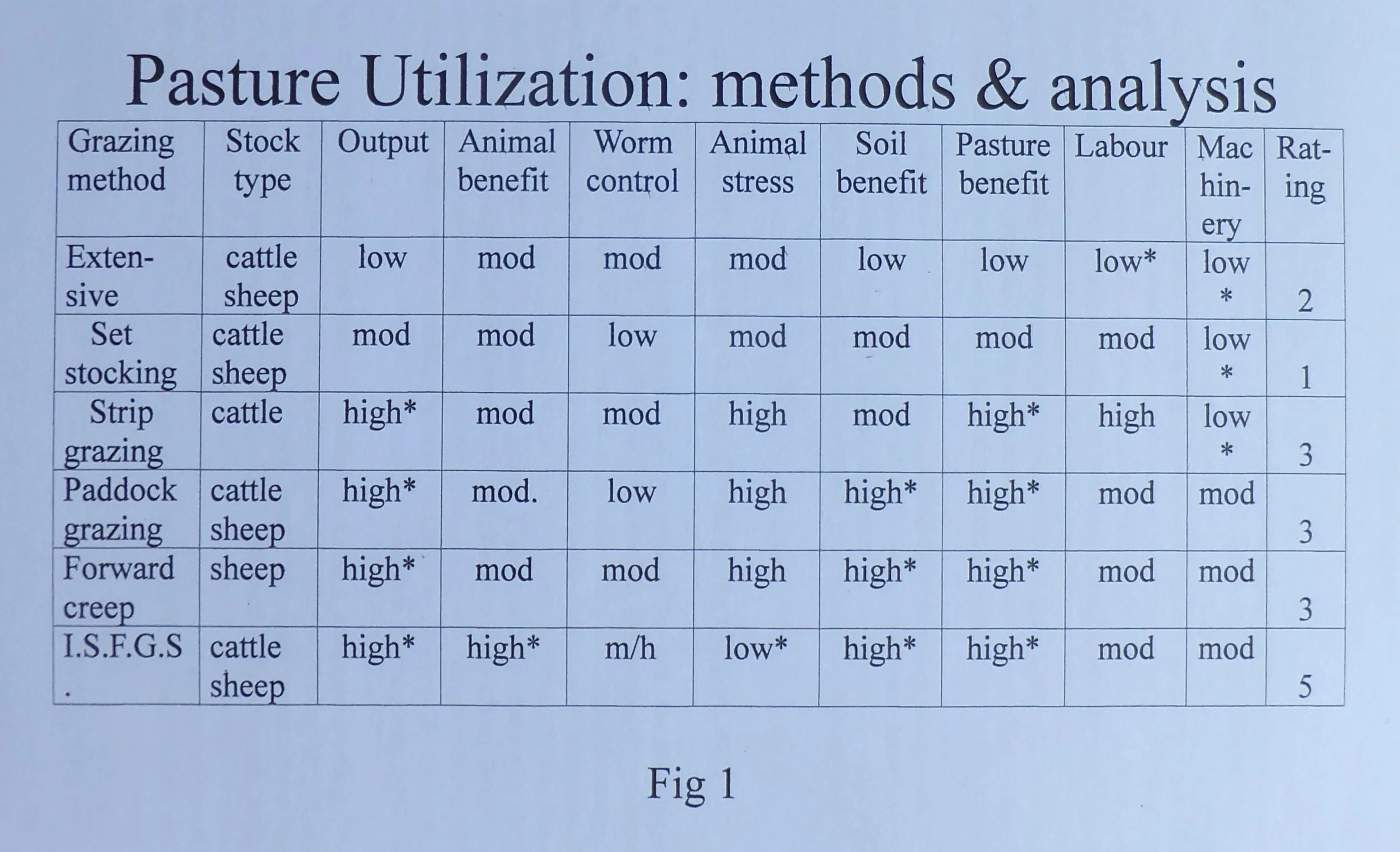
Turning now to theutilization of permanent pasturein summer. After conducting trials to assess various methods of grazing, it was discovered that none was entirely satisfactory. Yalland required a formal way of managing the grazing of beef cattle and prime-lamb-producing sheep; one that delivered positive features like productivity and gut worm control, while avoiding negative outcomes such as pasture degradation, unnecessary stress to livestock and fluctuating herbage availability. In short, a combination of mixed and rotational grazing, plus the ability to provide the most deserving groups of animals with the best available herbage. An attempt to summarise the situation is shown in Fig.1 Pasture Utilization: methods and analysis.
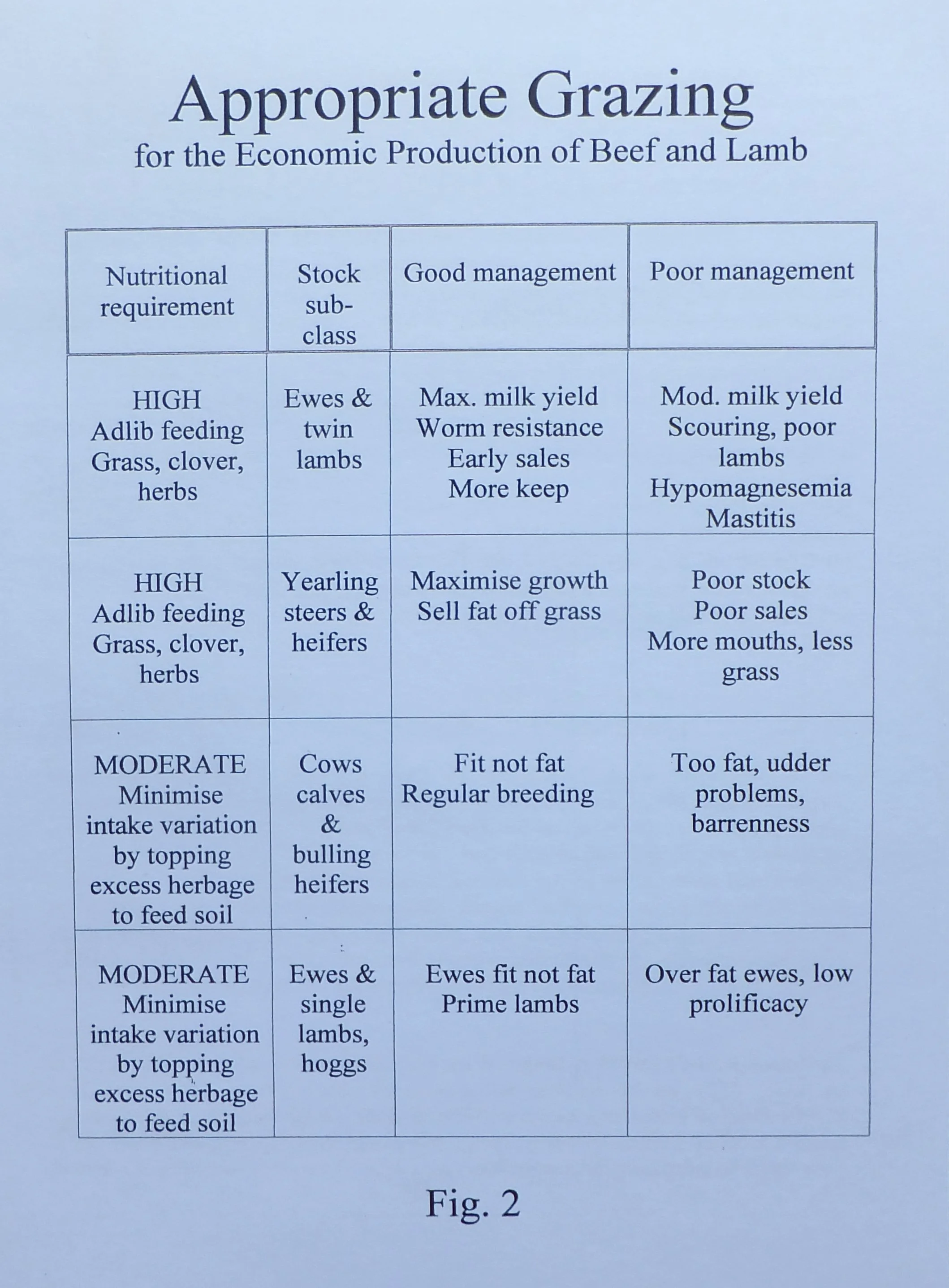
“Mixed grazing” suggests a general balance in live weight between cattle and sheep. But, if genetic potential is to be realized, certain classes of cattle and sheep should be favoured over the rest. Fig.2 “Appropriate Grazing” sets out the situation. It can be seen from this tabulation that there are two obvious “pairings” in terms of live weight balance: 1) multiple suckling ewes, with cows, calves and bulling heifers; and 2) yearling cattle, with the single couples and hoggs. Further examination reveals each “pairing” is made up of a high, and a moderate nutrition group of animals.
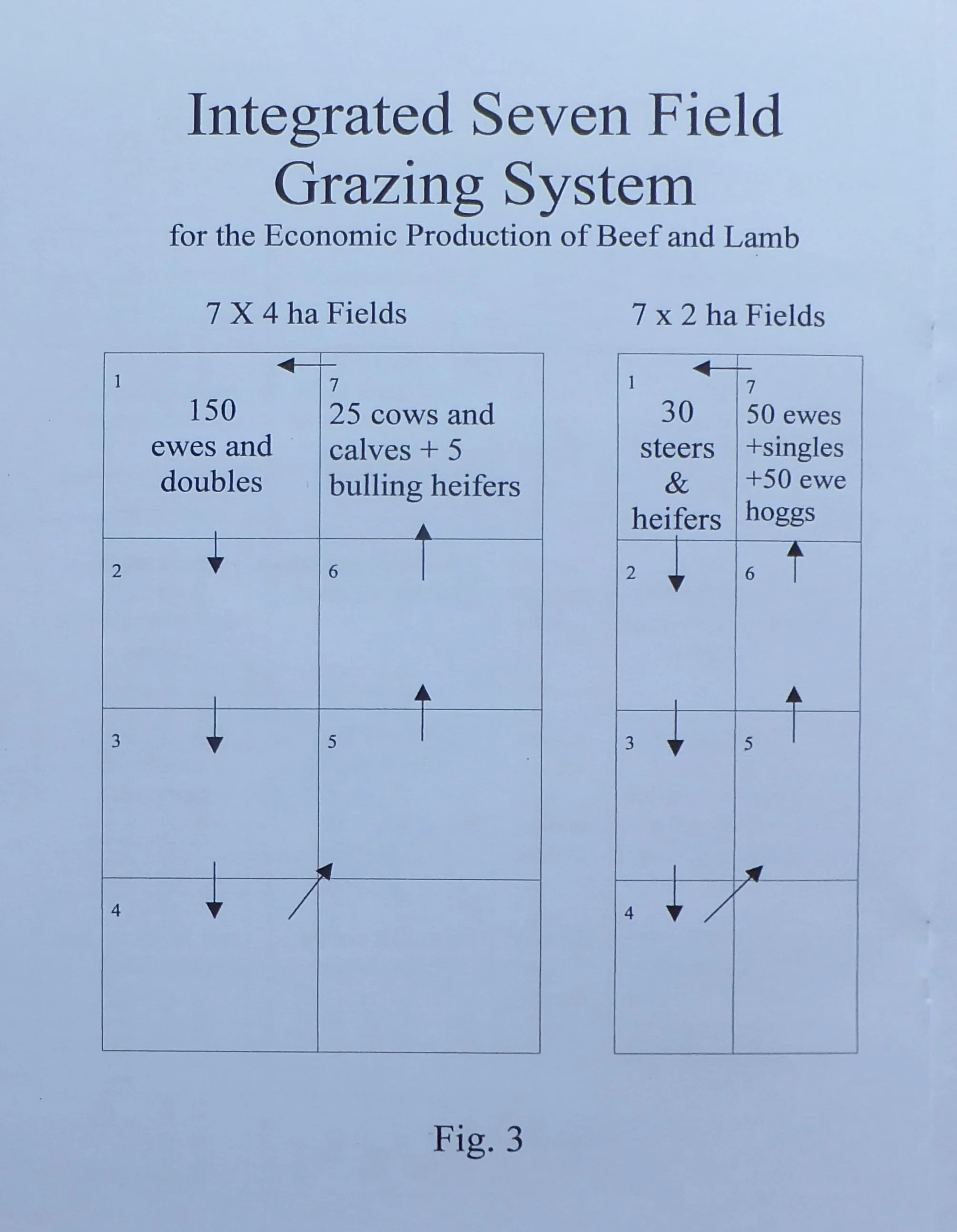
This information gave rise to the IntegratedSeven-FieldGrazingSystem(ISFGS). This method makes it possible for the farmer to achieve two objectives: to provide appropriate grazing for each group of animals in a “pairing”; and to reproduce the conditions of “mixed grazing” without actually having cattle and sheep in the same field. Hence, the “high nutrition” group grazes a field first, followed a week later by its “moderate nutrition” partner.
Employing the leader-follower technique in this way has two additional benefits when compared with single species rotational grazing: the number of animals in a field is halved, to reduce stress; and the hazardous fluctuations in herbage availability when livestock is moved to a fresh field is reduced. Fig.3 is a diagram that shows how two independent seven-field grazing systems can provide appropriate herbage for each sub-class of livestock on the farm.
In 1991, with the help of Seale Hayne Faculty of Agriculture’s head of Animal Husbandry department Dr. Alan Cooper, a trial was set up at Yalland to test the effect of the Integrated Seven Field Grazing System on gut worm infection in twin lambs. Honours Degree student Lena M. Bovis, conducted the trial entitled Management of Nematode Burdens in Organic Lambs. The trial started on May 1st. and lasted 14 weeks. The control sheep occupied a standard six paddock set up. Faecal egg counts were taken every three weeks. The result was:
Control lambs 100% ISFGS lambs 43.8 %
Plus 9.19 kg
These figures suggest that the ewes in the ISFGS have responded to the continuous supply of top quality herbage by providing their lambs with extra milk, and this in turn has meant that the lambs have not had to graze too much too early in life, before immunity to gut worms has had time to develop. It was hoped that by making it easy for the ewe to realize her milking potential, twin lambs might perform in a way similar to single lambs. Single lambs seldom suffer much from gut worms because they get more milk, and as a consequence pick up less infection. ISFGS has one further card to play, and that is the dilution-with-grass factor. If there is twice as much grass there is half the infection.
What are the mechanics of setting up an Integrated Seven Field Systemand how does it all work? First, there must be at least 54 ha. (135 acres) of “farmable” grassland available, land on which a tractor can safely be used. ISFGS is a “vital component” in a whole-farm grazing system called Yalland System Beef and Lamb, and so fields (enclosures, paddocks, amalgamations of fields etc.) will be designated to one of four categories according to size, degree of slope, and proximity to the farmstead. The minimum basic requirement is as follows:
No. Size. Use. Total area.
7 4 ha. (10 a.) - ewes/twins, cows/calves - = 28 ha. (70 acres)
7 2 ha. (5 a.) - yearling cattle, couples/hoggs - = 14 ha. (35 acres)
5 2 ha. (5 a.) - near farmstead, silage/hay/lambs - = 10 ha. (25 acres)
1 or 2 - general purpose fields at farmstead - = 02 ha. (5 acres)
Total 54 ha. (135 acres)
Second, there must be a coherent farm infrastructure to make it easy to provide the appropriate grazing quality for each sub-class of animal. This infrastructure also aids the farmer in achieving a high standard of husbandry across the whole farm enterprise.
Every farm will have its own characteristics when it comes to field size, and in the hills, due to the need for shelter, fields tend to be small. At Yalland, fields ranged from two-and-a-half to seven acres, and so some banks between adjacent fields were partly removed to create enclosures of nearer to the target sizes.
Typically, about a quarter of the bank’s length with its growth of thorn, hazel, ash etc. would be left intact at the centre of amalgamated fields. The top growth along the two remaining sections of bank would be cut down for firewood. A large machine would place the unwanted bank against the retained central section to form triangular reservation. This would be permanently fenced off to allow regeneration. Within one season a vigorous new spinney would be created. This new natural no-go habitat occupies an area similar to that of the original bank, but offers better prospects to a greater variety of birds and insects. A central reservation of this sort gives shelter from wind and sun at all times, and is arguably environmentally superior to what was there before.
It is not necessary to have all seven fields in a particular category together in one block, although it obviously helps when adjacent fields can be grazed in sequence. The most important thing is that each field can be serviced independently. This may involve adding a fence here and there to create some green drift ways. As a general rule, adjacent fields should always have a communicating gateway, though these can be simple affairs made with two six-foot sheep hurdles with an electrifiable wire above for cattle.
Topping, or cutting any herbage which remains after a period of grazing, is necessary for pasture improvement and the maintenance of good quality grassland.The purpose of topping is simply to complete the process of grazing, that is, to recycle all un-grazed herbage. If this is not done, the effect is to encourage those plants that the grazing animal dislikes, and over a period of years these “weeds” will come to dominate the pasture.
Therefore, at the beginning of each five-week recovery period the pasture is topped. The height of cut should be set at 5 cm (2 ins). Scalping should be avoided; the plants would be damaged. Cutting too high, on the other hand, will not stimulate re-growth low down, and weeds may be missed. A dense, productive pasture is the objective, a thorough and workman like job is called for.
In order to ensure the best outcome, due consideration should be given to the type of topping machine employed and the way it is used. Here are some points to bear in mind:
1 – The machine must be completely offset to ensure a clean cut; it is no good if herbage escapes cutting where the tractor wheels have run.
2 – Cut material should be moved sideways away from where it grew, helping to even out soil fertility within the field. Three gear driven rotors
giving an eight-foot width of cut works well.
3 – Height-of-cut is best controlled with skids, they follow the ground better than wheels, and don’t have bearings, get punctures, or wear out.
IN CONCLUSION
This booklet has concentrated on the fundamental issues affecting the commercial production of red meat from marginal (grade 4) grassland. It argues for an optimum size of farm, laid out to enhance pasture productivity and livestock performance. It also suggests that the agriculturally qualified young couple is best placed to make use of the forward-looking, experimental work carried out at Yalland.
For reasons of brevity, no attempt has been made here to include innovations and trials carried out in animal husbandry, crop husbandry, fencing and management; these will be discussed at length sometime in the future.
In this time of peak-oil, global warming and food shortage, the Yalland system has more to offer than the financial efficiency already noted. Here are some of the more obvious up-to-the-minute points to consider:
1 – Red meat is a truly beneficial food for humans when produced from grass.
2 – Grassland maintained without artificial fertilizers, reduces harmful emissions.
3 – Properly maintained permanent pasture captures progressively more carbon with every year that passes.
4 – Farmland suitable for arable crops should be used to grow food for people, and not ruminant animals.
5 – The Lance Method of Vacuum Compressed Silage requires less power and polythene than big-bale silage, and the grades that are used can be recycled.
6 – Yalland System Beef and Lamb does not require motorised equipment for feeding livestock during the winter at all, a horse and but-cart proved best, and the way that silage was fed virtually eliminated waste.
7 – The independent nature of the whole enterprise reduces liability to disease, increases satisfaction and leads to greater efficiency.
*
Back to home page Yalland Vacuum Compressed Silage
APPENDIX 1
AN INTRODUCTION TO THE YALLAND METHOD OF VACUUM COMPRESSED SILAGE
Vacuum compressed silage originated in New Zealand. Pilot trials were laid down at the Ruakura Research Station in 1959, after black polythene sheeting became available for use in agriculture.
New Zealand Department of Agriculture machinery instructor Mr. J. L. Deutre, and Mr. C. G. Jowsey the representative of a New Zealand plastics company, experimented with the sheeting to see if a way could be found to reduce the wastage common to silage made in field clamps.
They came up with the idea of laying a plastic sheet on the ground; loading it with flail harvested grass; covering the stack with a second sheet; clamping the two sheets together by means of a sealing device called Strip seal; then pumping the air out of the silage “envelope” via a perforated “stack-pipe” laid on top of the grass and taped out through the top sheet. They found that a vacuum of eight-to-ten inches of mercury would reduce the stack to “the solid state”. That is a pressure equivalent to two-meters (six feet) of concrete pressing down all over the stack. The air remaining in the grass is converted to carbon dioxide and water in the process of respiration. A clamp saturated with carbon dioxide guarantees correct lactic acid fermentation to preserve the grass. No additives are required.
The invention of Strip seal in 1962 was the real breakthrough, making it possible to seal and unseal the silage envelope in a simple and practical way. Strip seal consists of a half-inch Alkathene channel pipe into which a smaller pipe can be pressed to hold several layers of 300 gauge (75 Mu) polythene sheeting. The result was the most efficient, versatile and inexpensive way of conserving grass yet devised.
The technique was such an advance, that it was stated 800 New Zealand farmers had made “vacuum silage” in the three years to 1965. The first British stack of vacuum silage was made in 1964 by Richard Walley, a young farmer who had returned to his Cheshire dairy farm after visiting New Zealand on a Nuffield Scholarship. He had seen vacuum silage being made during his study tour, and was keen to try the system for himself. Farmers Weekly carried the story of this first stack on November 6, 1964.
I wrote to Dick Walley expressing an interest in vacuum silage, and received a copy of his tour report. The following spring (1965), there was an invitation to a presentation to be given by George Jowsey. The venue was a dairy farm near Barnstable in Devon. I was working farm manager at Yalland, a 162 acre (65 ha) beef and sheep farm situated in the foothills of Dartmoor. The farm owner and I attended the talk and slide show, about ten farmers were there. After the presentation, George was persuaded to delay flying back to New Zealand so that he could show us all how the process worked.
A hastily organised demonstration took place not far away two days later. A cube shaped stack was constructed from a trailer load of direct cut, lush grass on a misty morning in late April – dairy cows were strip-grazing another part of the field. The stack was sealed, and evacuated by means of a slurry tanker.
Farmers present that day were given the chance to purchase Strip seal that George had brought with him from New Zealand. On the strength of what had been learned and seen, we decided there and then to adopt this new system at Yalland. I had already planned to make seven “molehill” type field stacks, and so we took home enough Strip seal to do the job. Where the Strip seal had been manufactured, would later prove to be of crucial importance.
The local MAFF officer was in on the game, and had already taken samples of the fresh cut grass before we arrived. About three weeks later we received a letter from MAFF giving the silage analysis. Fermentation was good (pH 4.0) and the silage sweet. This small stack was proof that vacuum silage had great potential, giving the farmer complete control over the ensilage process. A process which, by virtue of its efficiency, would do away with the need for additives to ensure correct fermentation.
Later that season, Dick Walley, in association with Stevens (Plastics) Ltd., was marketing “Vac-Sile” kits made in the UK. More than 1,000 British farmers purchased kits in 1965, amounting to a capacity of over 100,000 tons of silage. In those days, the staff at your local MAFF office were there to assist farmers in any way they could, and it was all part of a free service. In our area, Totnes in Devon, they were very helpful, gathering information and providing lists of contacts. They took a keen interest in the outcome of all the trial vacuum silage made in Devon, and visited the pioneer farms when the stacks were opened up for winter feeding. They took samples for analysis, and made notes about waste and so on.
A report was published by the University of Exeter Department of Agricultural Economics, and copies were sent to the thirty farmers participating in the survey. Significantly, four of our seven stacks had no waste, all the other stacks in the survey had suffered varying degrees of spoilage due to air getting to the silage during the period of storage.
Our local MAFF team arranged an “open day” at Yalland: we had sheep self- feeding and stacks for carting to cattle. There was a lot of interest, even a visit from the Israeli Minister of Agriculture! More farmers made vacuum silage the following year. A local MAFF meeting was packed with farmers wanting to hear-all-about-it. Unfortunately, apart from reciting from a list of do's and don'ts gleaned from New Zealand farming journals, there was not a lot the advisers could say, because a complete and technically sound procedure had not at that time been developed. Farmers were still using a buck rake to move dumped trailer loads of fresh harvested grass on to square sided stacks, or to fill bunkers; thus re-creating the age old problem of silage stacks rotting at the sides.
However, the vacuum silage technique did at least replace the laborious, and often dangerous, task of squashing air from ensiled grass by driving back and forth over it with a tractor. It also guaranteed correct fermentation; a very palatable product; and in the event of unforeseen circumstances, the stack could be sheeted and pumped down to be completed at a later date without spoilage at the join.
Despite these advantages, the overall situation for most farmers was far from satisfactory: rotting, particularly at the sides of stacks, continued as before; polythene sheets were easily damaged and difficult to control in a wind; throwing back compacted ramp grass was very hard work; achieving an adequate vacuum when sheets had been damaged was time consuming; and using the UK manufactured Strip seal was difficult, because the Alkathene was less pliable. It was not surprising, therefore, that as realizing the full potential of vacuum silage was so problematic, many farmers became disillusioned and gave up. In our case, the early success we had gave clues for sound development and encouraged us to stay with the job, sort out the problems and make it work.
The purchase of two multipurpose Danish machines was turning point. The first was a side-mounted forage harvester with an attachment to windrow for hay making - trials at Writtle Agricultura College in 1960, found that grass cut by fail dries faster than any other method, and makes the best hay, even after rain. Wilting for silage was not much practiced in those days, but had a number of advantages for us:
It concentrated nutrients for in-lamb ewes, and enhanced fermentation
It allowed bigger trailer loads and faster field clearance
Building stacks was faster and easier
There was no silage effluent
It left a cleaner field
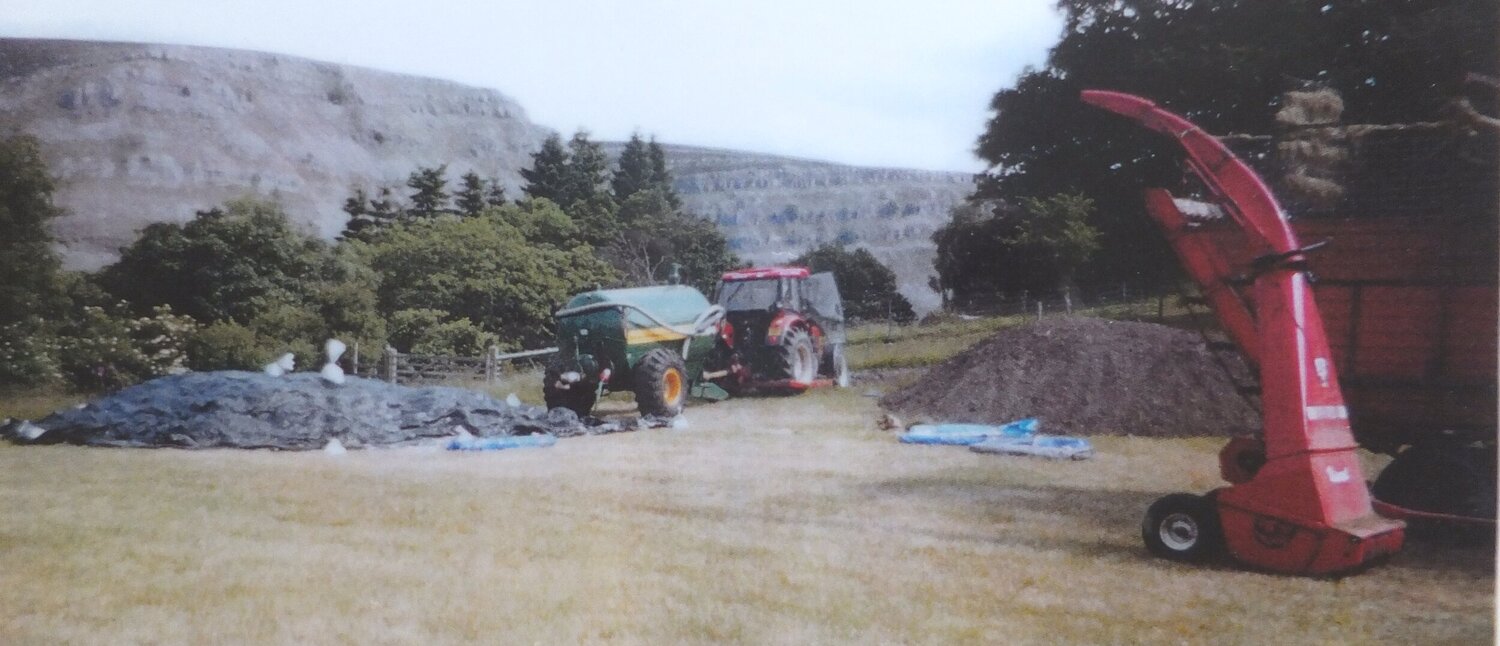
The second machine was a moving-bed trailer-type muck spreader, with a horizontal beater bar. This could also be used to set up compost rows when clearing out the sheep wintering sheds. The trailer could be converted into a forage waggon with a full-width, rear-unloading elevator. In this latter form, the load of wilted grass could be discharged directly on to the bottom sheet of a silage stack to form a rectangular heap, which proceeded load by load at the full stack height of more than three meters (10'). The procedure was simple and efficient, requiring only one man and a 60hp tractor.
To get an idea of performance, let us assume there is a 2 ha. (5 acre) field with a 25 tonne per ha. (10 ton per acre) standing crop of grass.
Day 1 – Mid afternoon cut and windrow
Day 2 – 11 am. The loading spout replaces the windrow attachment on the side-mounted forage harvester. The forage waggon hitches on a pto gearbox drawbar behind the tractor; either the forage harvester or the self-unloading trailer power shaft can be connected. In order to save time, stacks are made in the field of production; the forage harvester remains on the tractor. Harvesting the windrows and building the stack takes 8 hours, sheeting up and setting up the pump, another hour. So by 8 pm. You could be enjoying an evening meal.
An hour or so later, any leaks are taped over. If necessary, pumping continuesuntil the vacuum reaches 8” of mercury (the solid state). At this pressure (¼ of an atmosphere) the stack cannot be dented by pressing, as already stated, it is like having two meters of solid concrete on top. At this stage, a thicker re-usablesafety sheet is put over the stack and weighted down round the edges.
Day 3 – By morning, any oxygen that remained trapped in the grass will have been converted to carbon dioxide and water in the process of respiration. Carbon dioxide occupies twice the volume of oxygen, and so the top sheet balloons upwards. This phenomenon indicates the ideal conditions exist for the lactic acid forming bacteria to pickle and preserve the grass as silage. After two days the stack is inert, and ready for making safe long-term by covering with a layer of soil 100mm (4”) thick. Stacks are rectangular with 45 degree inward sloping sides and domed top.
If the weather is still good, the farmer should prepare to cut and windrow the next field in the afternoon (day 3). If the weather is unsuitable he must wait. The two-day sequence is repeated until four stacks have been made. The headlands of the last 2 ha. (5 acres) are taken to make a small stack for the cattle in November, leaving the rest for hay.
It is not possible to go into detail about techniques and organization in this outline, these things are best demonstrated on site. Suffice it to say that development has taken place over thirty years, and I have personally made more than 150 stacks varying in size from ten to 100 tons. I can be fairly sure that just about every “bright idea” has been tried, and what has emerged is versatile, simple, cheap and effective. In the context of what has been discussed here, making a living from beef and lamb in disadvantaged grassland areas, there does not appear to be any recent development in grass conservation to compare with LMVCS.
Our 65 ha. hill farm was typical of many a disadvantaged stock-rearing enterprise faced with ever increasing costs. Survival depended on producing more from the existing area and doing it more efficiently. The limiting factor was, and still is, feeding livestock through the winter and early spring. Following fashion, and borrowing money to buy more land at an uneconomic price made no sense to us, and proved to be unnecessary.